
Security awareness: from training to demonstrable behavior
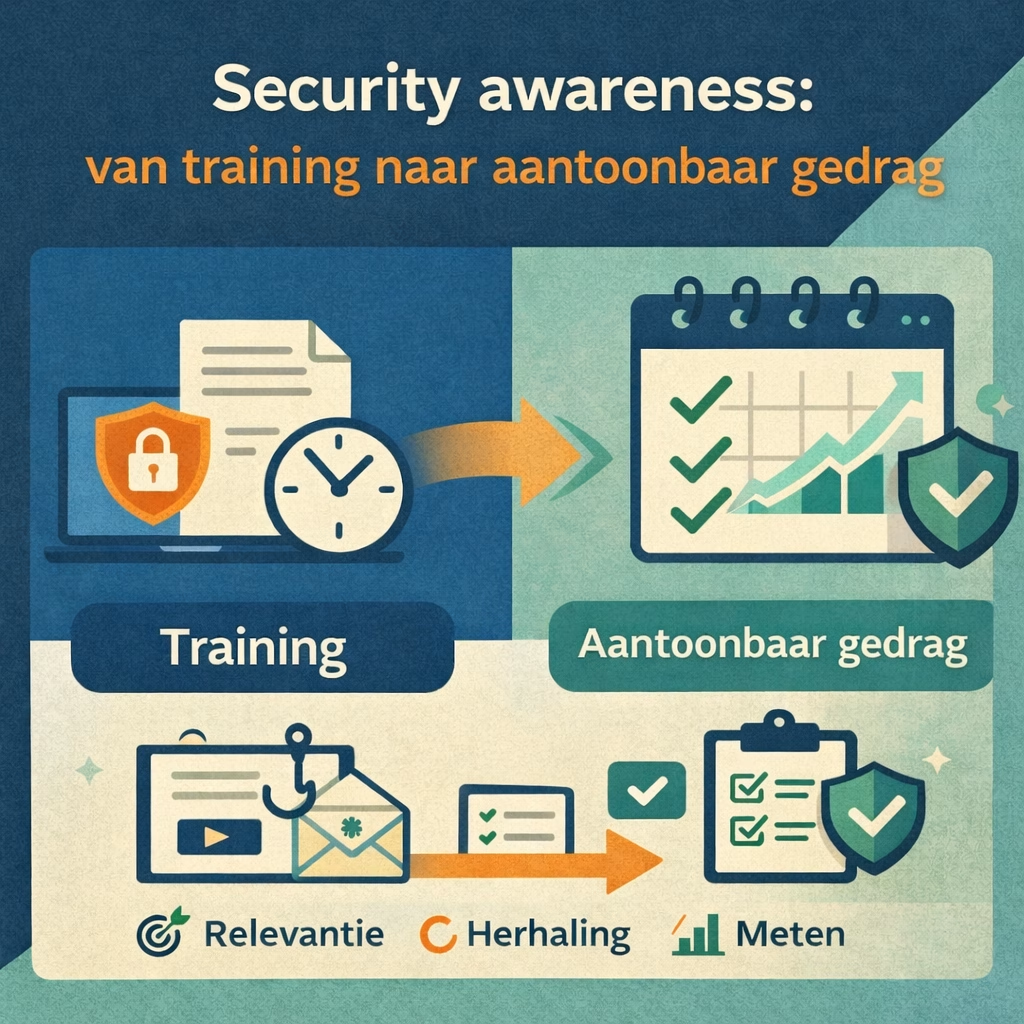
Security awareness is not a mandatory course that you check off once a year. It is the measurable link between policy and daily behavior - the place where an information security management system (ISMS) becomes visible in practice. ISO 27001:2022 makes that concrete in clause 7.3 en Annex A 6.3: employees must understand how their actions contribute to safety and what the consequences of non-compliance are. This goes beyond “knowing the policy”; it's about observable behavior.
Current events underscore this. With the introduction of the NIS2 Directive and the DORA Regulation security awareness becomes a mandatory part of governance. Organizations must show that everyone - including management - is adequately trained and that the training fits the role and risk. These legislative and standards frameworks thus call for a structural program with clear KPIs and audit evidence.
It is wise to realize that the scope always encompasses more than just IT systems. The primary care process is central, and that means you also need to look at processes, personnel, and suppliers. Therefore, a good checklist works as a roadmap through the entire ISMS (Information Security Management System).
Need help with Security awareness?
Our consultants are happy to help you.

Framework & Compliance Mapping: From Standard to Behavior
To prevent security awareness from becoming a disconnected campaign, it's necessary to anchor the program structure within existing controls.
ISO 27001:2022
- Clause 7.3 (Awareness) requires employees to demonstrate an understanding of which relevant information security policy points apply to them and their contribution to the ISMS.
- Annex A 6.3 (Awareness, education and training) is a continuous program that is role- and risk-based and periodically measures effectiveness.
NIS2
NIS2 continues: training is mandatory for all employees and management. Organizations must demonstrate how often and on which topics they train, and how knowledge is kept up to date. In the Dutch context, it advises National Cyber Security Centre (NCSC-NL) to move beyond traditional e-learning and focus on safe behavior in practice. This means more situation-specific exercises, shorter learning interventions, and feedback loops.
DORA
In the financial sector, writes DORA (Article 13, Paragraph 6) that all employees and senior management must receive regular training in ICT security and resilience. The content must align with their roles and operational risk. With this, security awareness becomes a governance responsibility, not an HR activity.
By mapping these standards to concrete behavioral indicators – such as the number of reported phishing attempts or the time between an incident and its report (Time-to-Report) – a direct link is created between training and risk reduction. Increasingly, organizations are working with dashboards that link these KPIs to ISMS objectives and audit evidence.
Program Architecture & Vendor Criteria
A security-awareness program is mature only when it is not about individual training sessions, but a structured system that influences behavior sustainably. The basis lies in three design choices: Relevance, repetition, and measurement.
An effective approach begins with Role and risk-based content. Employees who have access to sensitive data or operational technology have different learning objectives than someone in a support role. Many organizations therefore opt for short, repeatable micro-modules, supplemented with just-in-time trainingshort instructions directly after risky behavior, such as opening a suspicious link. This method significantly improves retention.
Additionally, modern awareness includes a behavioral dashboard. Gone are the days when only the click rate in phishing simulations counted. Organizations now measure report-rate (how often a suspicious mail is reported) and time-to-report (the speed of that notification). Together, those numbers show whether people not only recognize risk, but actively act on it.
When choosing a provider, more than price or quantity of content counts. Look to see if the provider meets the CCV Certified Cybersecurity Awareness Training., which provides quality guidelines for didactics, privacy, and demonstrability in the Netherlands. Also, check if the reports align with your own ISMS structure, so audit evidence can be automatically included.
Implementation Plan with Audit-Proof KPIs
A plan without metrics remains intentional. A good awareness program makes results demonstrable - so that audits are not about opinions, but evidence.
The implementation starts with a baseline measurementa culture scan and an analysis of risks per functional area. This data forms the basis for an annual plan with clear goals per department. Within ISO 27001 and DORA Are these plans linked to control objectives so that the relationship with governance remains visible?.
Next is the operating cycle: monthly phishing simulations with varying difficulty, coupled with immediate feedback. Mistakes lead to brief reinforcement learning moments, not punishment. This keeps the program focused on improvement, not blame.
To monitor progress, many organizations use three core KPIs:
- Report rate – the percentage of reports of suspicious messages.
- Time to report – the average time between receipt and notification.
- Resilience-ratio - the ratio of correct reports to errors.
These metrics provide a more realistic picture than just a click-through rate. Furthermore, when combined with SIEM data or ticket systems, a direct link is created between human behavior and actual incident response.
Finally, governance essential. Document each component in the ISMS: the awareness plan, the training calendar, the KPI reports, and the accompanying interviews or spot checks. This way, security awareness will not only be visible in dashboards but also in the audit trail.
Best practice patterns & pitfalls
Those who take security awareness seriously focus not on knowledge but on behavior. Yet, in practice, many organizations remain stuck ticking off courses. Publications from SANS and NCSC-NL show that programs are more successful when they align with employee practice and not just in policy.
A recognizable pattern in organizations with a mature awareness culture is the use of Role-specific content. Employees in operational technology or software development will encounter different scenarios than those in administrative roles. The point is that someone recognizes risks in their own work environment – not in a generic test environment.
A second pattern is the integration of Management training. Guidelines such as DORA and NIS2 emphasize that leadership must lead by example. Awareness then becomes part of strategic decision-making, not just the IT department.
In addition, many organizations are switching to multichannel training. Instead of just email modules, chat and mobile channels are also used, including scenarios for smishing and QR code deception. This keeps the program realistic and relevant.
What works less well is the fixation on the click-through rate. The number of employees who click on a link in a simulation says little about the organization's alertness. Only when you measure how many people receive suspicious messages report and how quickly that happens, insight into resilience is gained.
Another common problem is information overload: too much content in too little time. The best programs spread learning throughout the year, with short interventions and regular feedback opportunities.
Checklist: Audit-Proof Security Awareness
This checklist helps to structurally anchor security awareness in policy and audit evidence:
- Scope and governance: Name a responsible person and describe the objectives, resources, and reporting cycle.
- Norm mapping: link each activity to ISO 27001 (7.3 in A 6.3), NIS2 in DORA articles.
- Program: design role-based training, simulation rounds, and just-in-time interventions.
- Measurements: register report-rate, time-to-report, and resilience-ratio.
- Evidence Gather reports, interview notes, training logs, and management updates.
- Quality Work with suppliers who meet the CCV quality mark and ensure that privacy rules are complied with.
By combining these components, a complete picture emerges that not only meets legal and regulatory frameworks but also the daily need for measurable safety.