
ISAE 3402 vs. ISAE 3000: The Difference and Which One to Choose
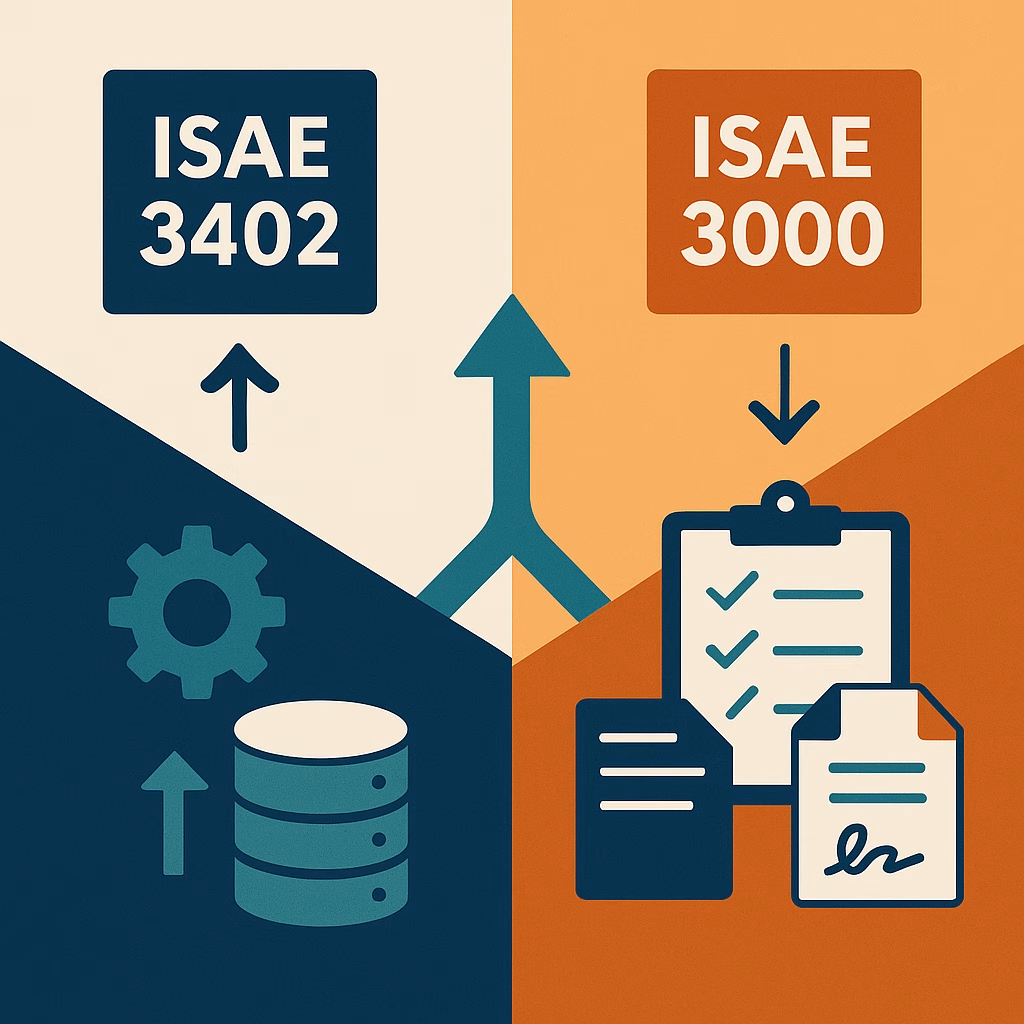
ISAE 3402 vs ISAE 3000: When it comes to responsibility for assurance within an organization, the choice between ISAE 3402 and ISAE 3000 will eventually arise. On paper, the standards may seem related, but in practice, they revolve around different objectives and expectations.
ISAE 3402 is developed for service organizations that perform processes affecting their clients' financial reporting. This includes payroll processing, financial administration, or asset management systems. The standard is closely related to US SOC 1 reporting and aligns with the internal control framework for financial audits.
Need help with ISAE?
Our consultants are happy to help you.

ISAE 3000, on the other hand, focuses on non-financial subjects. This standard provides room for assurance over subjects such as information security, privacy (GDPR), business continuity, and even sustainability (ESG). When there is no subject-specific ISAE, 3000 acts as an umbrella standard.
The right choice therefore depends on the scope of the service.
- Does a service have a direct impact on clients' financial results? Then ISAE 3402 is applicable.
- If it concerns trust in management controls related to security or compliance, without direct financial impact, then ISAE 3000 offers the appropriate framework.
The trend in both the Netherlands and the United Kingdom shows that organizations are increasingly combining both standards: 3402 for financial processes and 3000 for supplementary IT and compliance aspects.
Assurance types: Type I/II vs. limited/reasonable
Once the standard is chosen, the question follows: How deep should the inspection go?
At ISAE 3402 It concerns the setup, existence, and—in the case of Type II—the functioning of controls.
- A Type I report describes the situation on a specific date. It provides insight into the design of the control measures.
- A Type II report goes further: it demonstrates that these measures have been effective for a period of at least six months.
For report users — such as clients' external auditors — Type II offers more assurance. It gives them the ability to actually lean on the service organization's internal controls.
ISAE 3000 works differently. Here, one chooses between a limited or reasonable assurance.
- Limited Does that mean the auditor only draws negative conclusions: there is no indication that the controls are not working.
- Reasonable The auditor concludes that the controls are indeed effective.
The choice depends on the purpose of the assurance. For example, when an organization wants to demonstrate that information security measures have been consistently applied, a reasonable level of assurance is appropriate. For an initial assessment or pilot project, a limited level is often sufficient.
Sub-service organizations: carve-out vs. inclusive
Many service providers, in turn, use subcontractors, such as data centers or cloud providers. These parties fall under the umbrella term subservice organizations. Within ISAE 3402, there are two approaches to dealing with this:
- Carve-out The subservice is mentioned, but falls outside the scope of the assurance engagement. The responsibility then lies with the user organization to obtain additional assurance themselves.
- Inclusive The subservice is fully included in the assessment. This means that the auditor also performs testing at the subservice organization.
The choice between the two impacts the scope of the report and the confidence users can place in it. With a carve-out approach, the client must perform additional controls themselves or request separate assurance reports from the subservice.
In practice, the inclusive method requires more coordination, but it prevents overlapping audits and accelerates customer adoption.
Stakeholder expectations and reliance
An ISAE report is never intended for internal use only. The document serves as evidence for customers, auditors, and sometimes regulators. Therefore, it is worthwhile to determine in advance who will rely on the report and to what extent.
With ISAE 3402, this is often the client's external auditor. They use the report to determine the extent to which they can rely on the service provider's internal controls. A Type II report, in particular, offers sufficient assurance because it demonstrates that control measures have been effective over an extended period.
At ISAE 3000 shifts the perspective. The focus here is on compliance requirements and client trust in non-financial domains. Think of SaaS providers who want to demonstrate that their security and privacy measures are demonstrably effective. A report with reasonable assurance increases credibility in tenders and due diligence processes.
What is also important is clarity regarding User Entity Controls (UECs): control measures that the customer must implement themselves to ensure complete chain control. Clearly described UECs reduce discussions about responsibilities and reliance.
Checklist: From Preparation to Reporting
Those who prepare for an ISAE journey prevent time loss by setting the right conditions early on. The checklist below helps to sharpen the scope and expectations:
- Determine the scope - which processes, systems, and locations are covered by the investigation?
- Set leg control goals based on COSO, ISO 27001, GDPR or ESG criteria.
- Establish responsibilities – Who manages controls and who provides evidence?
- Choose the subservice approach – carve-out of inclusive.
- Gather evidence – logs, changes, tickets, reports.
- Document exceptions – including explanation and improvement actions.
- Adjust the assurance level – Type I/II of limited/reasonable.
- Check the trial period – a minimum of six months for Type II.
- Plan review periods – intern and with the auditor.
- Correct distribution – determine who receives the report and how bridging letters are handled.
This approach prevents the project from getting bogged down in loose controls or repeated audits. It aligns preparation with the expectations of external auditors and clients.